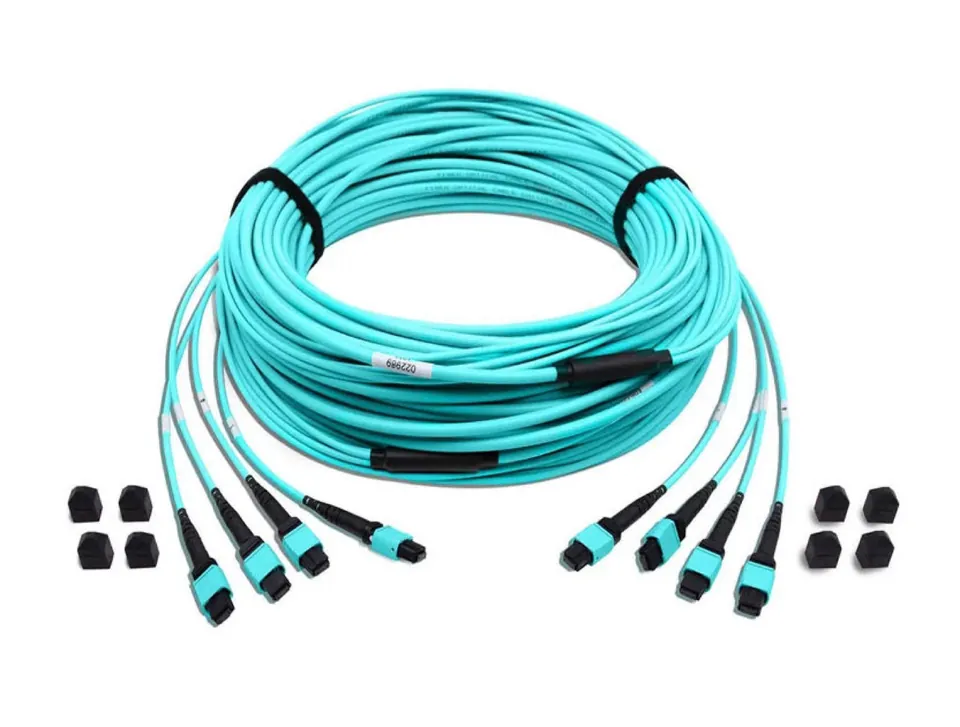
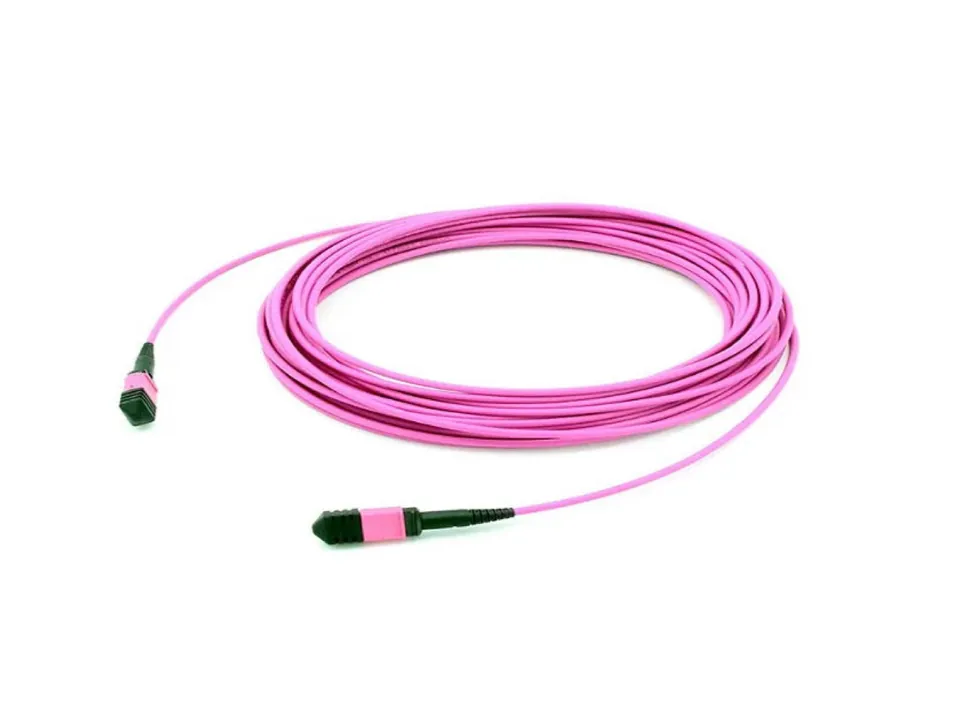
What an MTP MPO cable is
An MTP MPO cable terminates many fibres in one connector. The MPO (multi-fibre push-on) interface is defined in IEC 61754-7 and in TIA-604-5, and it holds the fibres in a single rectangular MT ferrule, in rows of 12 or 16. Alignment pins on one connector locate guide holes on the other, so every fibre in the row mates at once.
MTP is a trademarked connector design that conforms to the MPO standards and adds tighter mechanical tolerances and a floating ferrule. An MTP connector mates with a standard MPO connector of the same fibre count and key layout. In practice buyers search for an mpo cable or an mtp cable to mean the same family of assemblies, and the specification work is identical. The MTP versus MPO guide covers where the differences matter.
Parallel optics are the reason these assemblies exist. A 40G or 100G SR4 transceiver transmits on four fibres and receives on four, and 400G and 800G SR8 optics use eight in each direction. Duplex LC cabling cannot feed those ports directly, and a 12-fibre or 16-fibre MPO can.
Assemblies Radix builds
Every assembly is configured to order. Fibre count, connector, gender, polarity, jacket and length come from the customer's drawing or BOM rather than from a stock list.
| Assembly | Ends | Typical position in the link |
|---|---|---|
| Trunk cable | MPO to MPO, one or many legs | Permanent backbone between racks, rows or rooms, landing on cassettes or adapter panels |
| Patch cord | MPO to MPO, single unit | Short connection from a transceiver or panel to the next panel |
| Breakout or fan-out | MPO to LC, SC or other duplex legs | Joins a parallel-optic port or trunk to duplex equipment |
| Conversion harness | MPO to several MPO | Changes fibre count between equipment, for example one 24-fibre to two 12-fibre |
Each type has its own page: MPO trunk cables for the backbone, MPO patch cords for the equipment end, and MPO breakout cables and harnesses for the transition to duplex connectors.
Fibre counts and where each is used
| Fibre count | Ferrule layout | Common use |
|---|---|---|
| 8 | 12-position ferrule, 8 positions populated | 40G and 100G SR4 multimode, 400G DR4 single-mode |
| 12 | One row of 12 | General backbone and cassette systems; SR4 links use 8 of the 12 |
| 16 | One row of 16, offset key | 400G and 800G SR8 parallel optics |
| 24 | Two rows of 12 | High-density backbone, legacy 100GBASE-SR10 |
| 48 | Multiple ferrules or legs, per drawing | High-density frames and trunk runs |
MPO-16 connectors use an offset key so they cannot be mated with MPO-12 by mistake. A 48-fibre assembly can be laid out in more than one way, so the drawing should state how many connectors sit at each end and how fibres are allocated to them.
Fibre types: OM3, OM4, OM5 and OS2
| Fibre | Category | Usual jacket colour | Where it fits |
|---|---|---|---|
| OM3 | 50/125 laser-optimised multimode | Aqua | Short-reach 40G and 100G inside a hall |
| OM4 | 50/125, higher bandwidth than OM3 | Aqua, or violet in some markets | Longer multimode runs at 100G and 400G |
| OM5 | 50/125 wideband, 850 to 953 nm | Lime green | Shortwave wavelength-division optics |
| OS2 | 9/125 single-mode | Yellow | DR and FR optics, longer links, angled (APC) MPO end faces |
Multimode MPO connectors are normally polished flat. Single-mode MPO connectors are normally polished at an 8 degree angle (APC), and an angled connector must not be mated with a flat one. Reach depends on both the fibre and the optic, so choose the fibre against the transceivers planned for the channel over its life, including those not yet installed.
Polarity and gender
Polarity decides which transmit fibre arrives at which receive fibre. TIA-568 describes three connectivity methods built from three cable types:
- Type A: straight through, fibre 1 to position 1.
- Type B: reversed, fibre 1 to position 12.
- Type C: pairs flipped, fibre 1 to position 2.
The trunk, the cassettes or breakouts and the patch cords must follow one method end to end. Mixing them is the most common reason a new parallel link shows no light. The MPO polarity guide works through each method.
Gender is the second check. A pinned (male) connector has alignment pins; an unpinned (female) connector has holes. Two connectors meeting in an adapter need one of each. Transceiver ports are pinned, so a cord that plugs into a transceiver is unpinned at that end.
How to order MTP MPO cable assemblies
A quote can be returned quickly when the request states the following:
- Assembly type: trunk, patch cord, breakout or harness.
- Fibre count per cable and per connector.
- Fibre type: OM3, OM4, OM5 or OS2.
- Connector at each end, gender at each end, and end-face polish.
- Polarity type (A, B or C) and how the rest of the channel is built.
- Overall length, length tolerance and, for breakouts, leg length and stagger.
- Jacket: LSZH, plenum or riser rating, or armoured.
- Pulling grip, labels and marking at each end.
- Test data required, and the maximum insertion loss per mated pair.
- Quantity per configuration.
Radix measures insertion loss and return loss on each channel. TIA-568 allows up to 0.75 dB per mated connector pair; if your loss budget assumes a lower figure, state it so the quote can confirm it. Send the drawing or the list above through the request a quote page.
Questions buyers ask
Are MTP and MPO cables interchangeable?
Yes, for the same fibre count, key layout, polish and gender. MTP is an MPO-compatible design with tighter tolerances, so an MTP connector mates with a standard MPO adapter or connector. Check that one side is pinned and the other unpinned.
Which fibre count do I need for 400G?
It depends on the optic. 400G SR8 and 800G SR8 multimode use 16 fibres on an MPO-16. 400G DR4 single-mode uses 8 fibres on a 12-position APC MPO. Check the transceiver datasheet before choosing the cable.
Can you build single-mode MPO assemblies?
Yes. OS2 MPO assemblies are built with angled (APC) end faces as single-mode parallel optics require. State APC on the drawing and make sure the adapters and cassettes in the channel are also angled.
Which polarity type should I order?
Match the method already used in the channel. If you are designing a new channel, choose one method, often Type B for parallel optics, and order trunks, cassettes and cords to that method so the whole run stays consistent.
Can I order non-standard lengths?
Yes. Lengths are cut to the drawing rather than chosen from a catalogue list. Give the overall length, the tolerance you need and the leg lengths for any breakout end.