
What armour does and does not do
An armoured fibre optic cable (armored fiber optic cable in US usage) adds a protective layer between the fibres and the outside world. The armour takes crush loads, resists rodent bites and survives impacts that would kink an unarmoured cable. It does not make a cable waterproof, flame retardant or tolerant of tight bends; those properties come from the jacket, the water blocking and the cable design.
Armour also adds weight, outer diameter and bend radius. Specify it where the route needs it, not by default. The armoured versus unarmoured guide sets out when an unarmoured cable in protected containment is the better choice.
Armour types compared
| Armour | Construction | Typical route | Point to check |
|---|---|---|---|
| Corrugated steel tape | Longitudinally applied steel tape under an outer jacket | Duct, direct burial, inter-building | Conductive, needs bonding |
| Steel wire | Layer of galvanised steel wires | Direct burial, heavy crush or pulling loads | Heavy, large bend radius |
| Interlocking aluminium | Helically wound aluminium strip | Indoor risers and exposed runs inside buildings | Conductive, needs bonding |
| Stainless steel spiral tube | Flexible steel tube inside the patch cord jacket | Armoured patch cords, floor and machine runs | Flexible, light, protects short lengths |
| Dielectric (tactical) | Aramid strength members under a tough polyurethane jacket | Deployed, temporary and vehicle-crossed runs | No metal, no bonding needed |
Under the US National Electrical Code (Article 770), a fibre cable with metallic members is classified as conductive, and those members are bonded where the cable enters a building. In installations near high voltage or lightning-exposed structures, an all-dielectric construction avoids the question entirely.
Armoured tactical cable assemblies from Radix
Radix manufactures terminated armoured and tactical assemblies. These are the lines buyers specify most often:
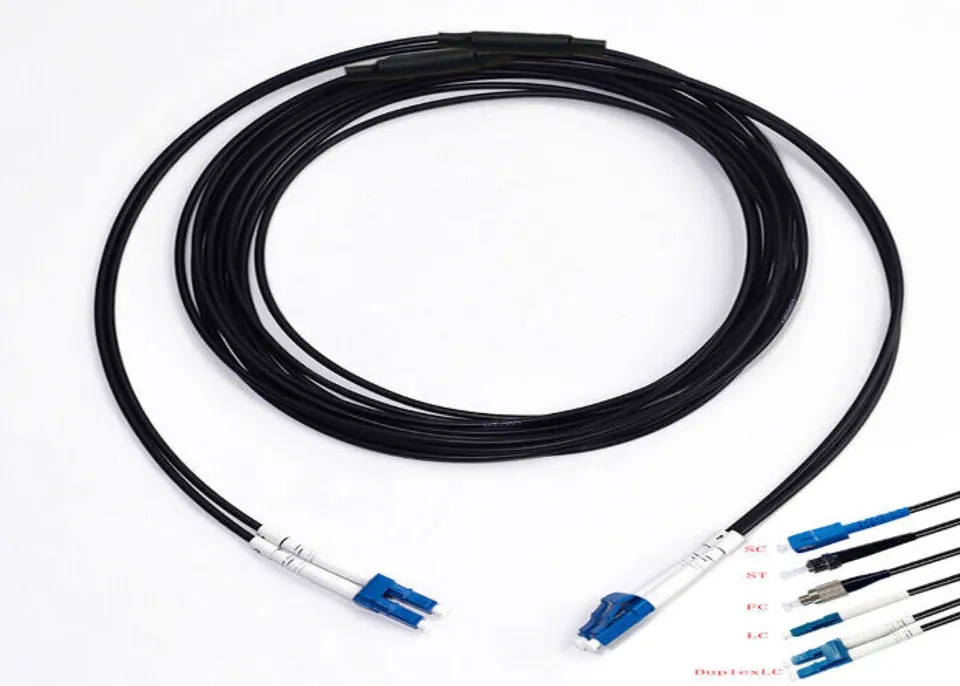
- LC, FC, SC and ST duplex armoured tactical cable for campus, riser and floor links where a standard patch cord would be crushed.
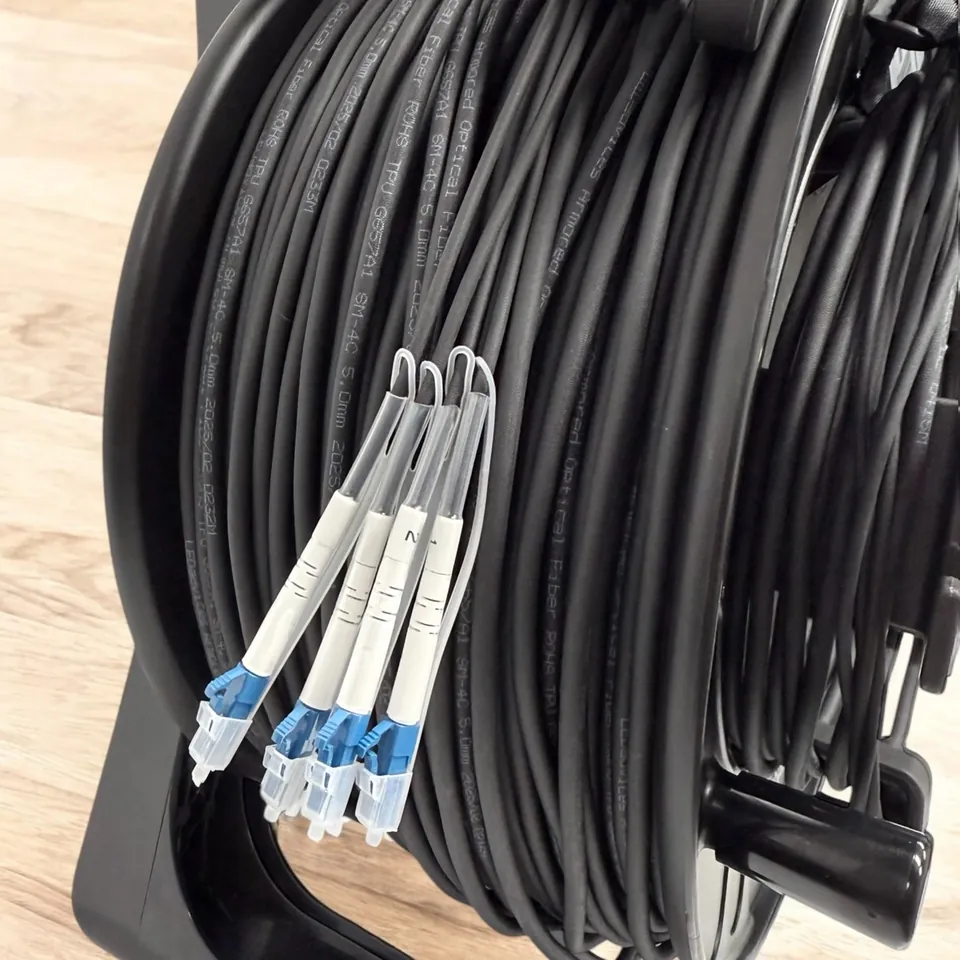
- LC, FC, SC and ST 6-fibre armoured tactical cable where several circuits share one protected run.
- Tactical HMA fibre optic cable rated for crush and repeated drag in deployed use.
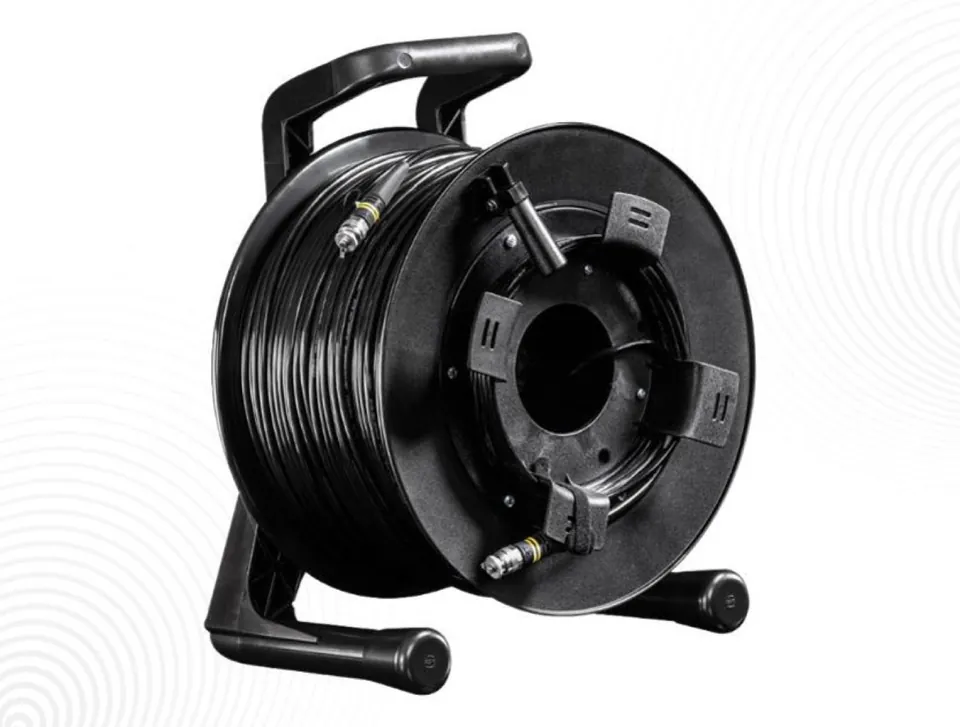
- Tactical cable reels that lay and recover quickly in the field.
Each is configured to order: fibre type, fibre count, connector at each end, length and marking come from the buyer's drawing.
Indoor, outdoor and deployed routes
Indoor. Inside occupied buildings the jacket rating usually matters more than the armour. Specify LSZH where low smoke and zero halogen are required, or a riser or plenum rating where North American codes apply. Interlocking aluminium or spiral steel protects exposed runs without the bulk of wire armour.
Outdoor and buried. Outdoor cable needs a UV-stable jacket and water blocking, gel-filled or dry, along the core. Steel tape or wire armour resists rodents and backfill. Plan where the armoured cable transitions to indoor cable, and whether the armour is terminated and bonded at that point.
Deployed. Tactical cable is laid, driven over, recovered and laid again. A polyurethane jacket over aramid gives crush and abrasion resistance with a small bend radius and low weight, and the reel matters as much as the cable.
Reels and field handling
Long tactical runs are supplied on reels so the cable can be paid out from a vehicle or by hand and recovered without kinking. When ordering a reeled assembly, specify the reel type, the length per reel, whether the inner end must be reachable while cable remains on the reel, and how the connectors are capped and stowed during transport. Dust caps on field connectors are part of the specification, not an accessory; a contaminated end face is the most common cause of a failed field link.
For fixed outdoor installations a drum or reel is simply transport packaging. State the maximum reel size the site can handle and whether the cable will be pulled from the reel in one length.
Terminating armoured cable
Armour has to stop somewhere behind the connector. On a factory assembly the armour is anchored in a breakout or boot, and short unarmoured legs carry the connectors to the equipment. Give the length of those legs on the drawing; long legs are easier to dress, short legs are better protected.
Connector choice follows the environment. LC and SC suit protected equipment rooms. FC with its threaded coupling holds in vibrating equipment. Sealed MIL, ODC or expanded beam connectors suit field ends that are mated in dirt and weather.
Specifying an armoured fibre assembly
- Route description: indoor, outdoor, buried, aerial or deployed.
- Armour type, or the threat it must resist (crush, rodent, vehicle traffic).
- Fibre type and count.
- Jacket material and fire rating.
- Connector at each end and leg length beyond the armour.
- Overall length and tolerance, and whether the cable is supplied on a reel.
- Cable marking and labels.
- Required test data.
Radix measures insertion loss and return loss on each channel. Ask for the cable's minimum bend radius, crush rating and weight per metre in the quote, as these vary by construction. Send the details through the request a quote page.
Questions buyers ask
Does armoured fibre cable need to be grounded?
Metallic armour makes a cable conductive, and building codes such as the US National Electrical Code require its metallic members to be bonded where it enters a building. Dielectric and tactical cables have no metal and do not need bonding.
Is armoured fibre cable rodent proof?
Steel tape and steel wire armour give strong resistance to rodent damage, which is why they are used in ducts and buried routes. No cable is rodent proof in every condition, so combine armour with suitable containment.
Can armoured fibre be used indoors?
Yes. Interlocking aluminium armour and spiral steel tube armour are common indoors. The jacket must carry the fire rating the building requires, such as LSZH or a riser or plenum rating.
What is the difference between armoured and tactical fibre cable?
Armoured cable uses a metallic layer for crush and rodent protection in fixed routes. Tactical cable uses aramid and a tough polyurethane jacket to survive repeated deployment, recovery and vehicle traffic without metal.
Can you supply armoured cable on a reel?
Yes. Tactical and armoured assemblies can be supplied on reels, including tactical cable reels for field deployment. State the reel type and the length on the order.