Where an MPO patch cord sits in the channel
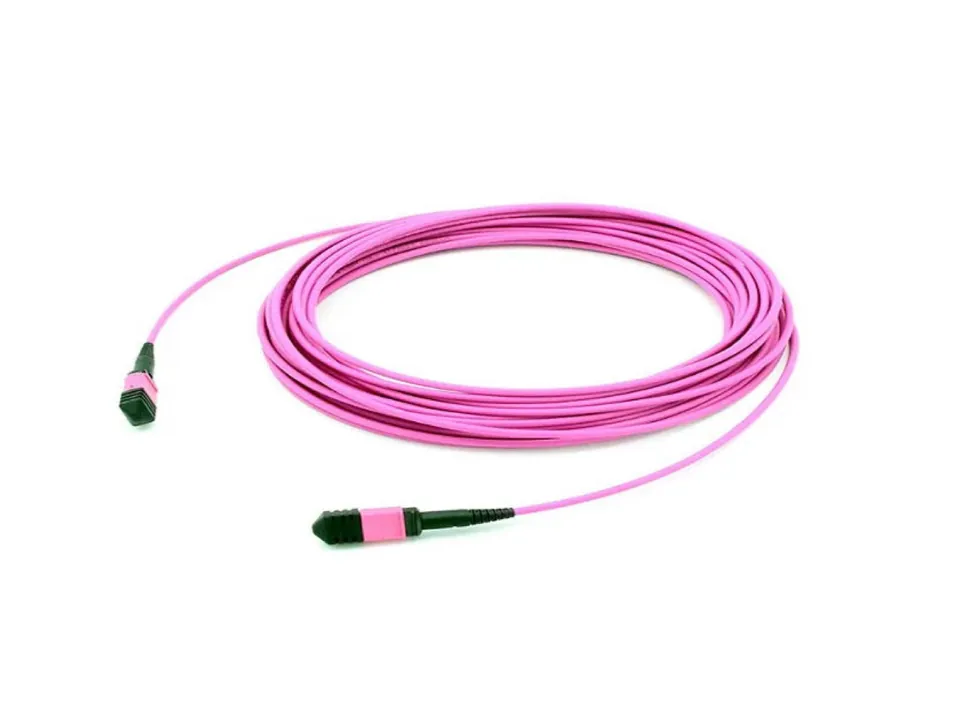
An MPO patch cord is the moveable part of a parallel optic channel. It connects a switch or server transceiver to a patch panel or cassette, or one panel to another, and it is expected to be unplugged and re-patched over the life of the installation. The permanent run between panels is an MPO trunk cable; the patch cord is the last metre or few metres at each end.
Buyers also search for an mtp patch cord. An MTP cord and an MPO cord of the same fibre count, key layout, polish and gender mate with each other; the MTP versus MPO guide explains where the designs differ.
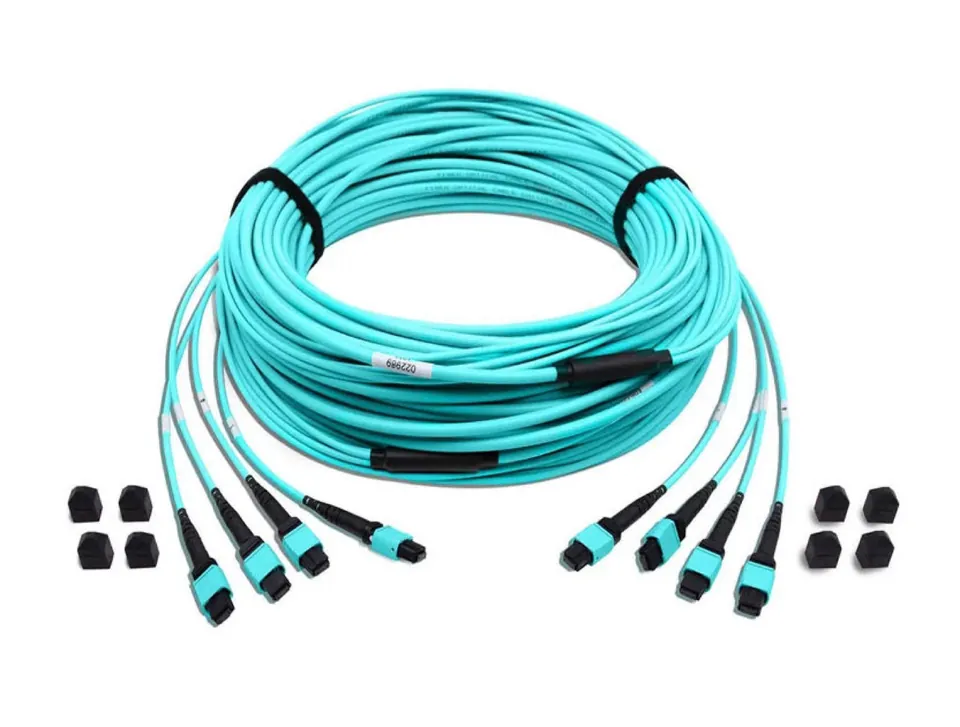
MTP OM3 48-fibre and MTP OM4 patch cords
Two lines in the range are specified most often for high-density frames.
- MTP OM3 48-fibre patch cords carry 48 fibres for high-density patching where frame space is the limit. State how the 48 fibres are split across connectors at each end.
- MTP OM4 patch cords suit 100G and 400G multimode links where the channel needs the extra reach of OM4 over OM3.
Both are configured to order. Fibre count, connector, gender, polarity, jacket and length are taken from the drawing.
Choosing the fibre count
| Port or optic | Fibres used | Patch cord to order |
|---|---|---|
| 40G or 100G SR4 multimode | 8 | MPO-12, flat polish, unpinned at the transceiver |
| 400G or 800G SR8 multimode | 16 | MPO-16, flat polish, unpinned at the transceiver |
| 400G DR4 single-mode | 8 | MPO-12, angled (APC) polish, unpinned at the transceiver |
| Panel to panel, 12-fibre system | 12 | MPO-12, gender to suit the adapters |
| Panel to panel, 24-fibre system | 24 | MPO-24, gender to suit the adapters |
Always confirm the fibre count and polish against the transceiver datasheet. An MPO-16 will not mate with an MPO-12 port because of its offset key, and an angled single-mode connector must not be mated with a flat one.
Gender and polarity
Transceiver ports carry the alignment pins, so a patch cord that plugs directly into a transceiver is unpinned at that end. A cord between two transceivers is unpinned at both ends. A cord between a transceiver and a panel adapter needs the opposite gender to whatever is behind the adapter.
Polarity must match the channel method. Depending on the method, the cord at each end may be the same type or a different type, so state the method used in the channel on the order rather than the cord type alone. A cord with the wrong polarity can look correct and still deliver transmit to transmit.
Jacket, length and handling
Patch cords are handled more than any other part of the channel, so jacket and strain relief matter.
- LSZH jackets for occupied rooms, or plenum and riser ratings where those codes apply.
- Round or flat construction to suit cable management, with an outer diameter stated if the frame is tight.
- Lengths cut to the rack layout, not rounded up to a catalogue length; surplus length becomes congestion in a dense frame.
- Labels at each end with the port and circuit identifiers your records use.
Every mating cycle is a contamination risk. Inspect and clean both end faces before each connection; the MPO cleaning guide covers tools and method.
Patch cords in high-density frames
In a dense frame the patch cord decides whether the frame can be worked on. A cord that is too long forms loops that block airflow and hide port labels; a cord that is too thick fills the vertical management before the frame is full. Give the cord outer diameter limit and the route from port to panel, and order lengths by position, not one length for the whole frame.
Identification matters as much as length. Label each end with the port and circuit identifier used in your records, and consider a distinct jacket colour for each fibre type or polarity method so a cord of the wrong type stands out.
Common ordering mistakes
Most returned MPO patch cords are electrically and optically sound. They fail because the order did not match the channel.
- Wrong gender: a pinned cord ordered for a pinned transceiver. The connectors will not seat, and forcing them damages the pins.
- Wrong polish: a flat multimode cord ordered for a single-mode DR4 port that needs APC.
- Wrong fibre count: an MPO-12 ordered for an SR8 port that needs MPO-16.
- Wrong polarity: the cord type matches the trunk label but not the method used in the cassettes.
- Wrong length: catalogue lengths that leave loops in a dense frame and block airflow.
A port list with the transceiver part number, the panel position and the channel method at each end removes most of these errors before manufacture.
Ordering MPO patch cords
For each configuration state the fibre count, fibre type, connector (MTP or MPO) at each end, gender at each end, polish, polarity method, length, jacket, label text and quantity. Radix reports insertion loss and return loss per channel; give the maximum loss per mated pair your budget allows. Send the list or drawing through the request a quote page.
Questions buyers ask
What is the difference between an MPO patch cord and an MPO trunk?
A patch cord is short, single-unit and moved during operation. A trunk is the permanent, often multi-unit backbone installed in containment between patch fields. Both use the same connector family.
Do I need a pinned or unpinned MPO patch cord?
Transceivers are pinned, so the cord end that plugs into a transceiver is unpinned. At a panel, choose the opposite gender to the connector behind the adapter. Two pinned or two unpinned connectors will not mate correctly.
Can an MTP patch cord connect to an MPO port?
Yes, when fibre count, key layout, polish and gender are compatible. MTP is an MPO-compatible design, so the two intermate.
Are OM3 MPO patch cords still worth specifying?
OM3 remains suitable where every channel is within the OM3 reach for the optics in use, such as 100G SR4 up to 70 m under IEEE 802.3. If channels are longer, or may be in future, OM4 gives more margin.
How should a 48-fibre MTP patch cord be specified?
State how many connectors are at each end, the fibre count of each connector and the fibre-to-position mapping. A 48-fibre cord can be laid out in more than one way, so the drawing removes ambiguity.