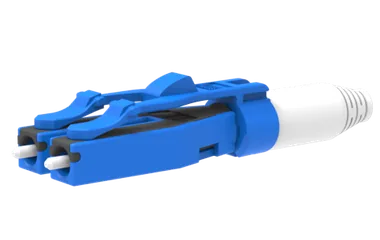
Connector
LC EZ-Flip Connector
Duplex uniboot LC connector that reverses polarity quickly, with a reduced profile latch and a push-pull tab option.
- Duplex
- Push-pull
- Polarity changeable
Click the photo to enlarge
LC connector with a push-pull boot and tool-less polarity reversing for fast changes in dense panels.
The LC EZ-Way is a duplex LC connector with a push-pull boot and tool-less polarity reversing. You insert and release it by the boot, away from neighbouring latches, and you can swap transmit and receive without cutting the cord. It suits crowded LC panels and sites that find polarity faults late.
| Type | LC connector, push-pull boot |
|---|---|
| Fibre type | Single-mode and multimode |
| Polish | UPC and APC (single-mode) |
| Typical insertion loss | 0.05 to 0.12 dB Premium LC single-mode, 0.12 dB standard LC |
| Maximum insertion loss | 0.15 to 0.25 dB Premium LC, 0.30 dB standard LC |
| Return loss | At least 55 dB UPC, 65 dB APC, 25 dB multimode |
| Operating temperature | -40 to +75 C |
| Durability | Under 0.2 dB change after 500 matings |
| Polarity | Tool-less reversing |
Figures are the manufacturer's published values for the product family and grade; check the data sheet for the exact part number you order. Radix confirms the build in your quote.
| Fibre type | Single-mode, Multimode, or other on request |
|---|---|
| Polish | UPC, APC, or other on request |
| Packaging and labelling | On request |
Radix supplies this part loose, or built into patch cords, pigtails and assemblies to your drawing, quoted by form, phone or WhatsApp from Pune.
Send us:
Add this part to your list, add more parts, then send one request.
The LC EZ-Way connector is a duplex LC connector in which the boot does the pushing and pulling. Two features define it: the push-pull boot and tool-less polarity reversing. The connector stays on the standard LC outline, so it mates with ordinary LC adapters, but its handling is different from a normal latch-and-clip LC cord.
It is one of the connector variants within the LC connectors and adapters range, next to the tab-handled LC EZ-Flip. Radix can supply it from loose or built into duplex cords to your drawing. If you are just starting with the format, read the LC connector guide first.
A standard LC latch is a small lever on top of the connector body. In a dense panel, with LC ports in close rows, a fingertip may touch three connectors while trying to press one latch. Pulling a cord by its cable is no answer: it loads the jacket and can unseat the neighbour. A push-pull boot moves the release point to the rear of the connector, where there is room.
This suits long rows of adapters stacked in two or three rows. For stacking, see the LC stackable adapter.
| Item | Manufacturer figure |
|---|---|
| Premium LC, single-mode, typical insertion loss | 0.05 to 0.12 dB |
| Premium LC, single-mode, maximum | 0.15 to 0.25 dB |
| Standard LC, typical and maximum | 0.12 dB and 0.30 dB |
| Return loss | At least 55 dB UPC, 65 dB APC, 25 dB multimode |
| Temperature | -40 to +75 C |
| Durability | Under 0.2 dB change after 500 matings |
| EZ-Way features | Push-pull boot, tool-less polarity reversing |
These come for the LC family. Read the data sheet for the grade of the EZ-Way you buy. For loss budgets the maximum is the number to use, see the fibre loss budget guide.
Polarity on a duplex link means each fibre goes to the right direction. EZ-Way allows the pair to be reversed without tools and without re-terminating, so a cord found crossed can be corrected in place. Use the manufacturer instruction sheet for the exact steps.
The general method for tracking where a channel is crossed is in the fibre polarity testing guide.
| Connector | Handling | Polarity | Best where |
|---|---|---|---|
| LC EZ-Way (this page) | Push-pull boot | Tool-less reversing | Rows are crowded and boots can be gripped |
| LC EZ-Flip | Latch with tab option | Quick reversing, uniboot | Tab access is good |
| LC-HD | Low profile trigger | Not the point of this part | Panel density is the goal |
| LC keyed | Standard | Fixed, colour keyed | Networks must not be mixed |
For the same boot-pull idea on the smaller format see the CS EZ-Way connector.
Assume a patch field uses a three-row stacked adapter layout with 72 duplex cords per panel, and technicians report that unplugging a cord in the middle row disturbs neighbours (assumed).
Trial first, because boot thickness and spacing vary and some stacked panels leave little room for any boot.
The boot is a structural part. It carries the push and the pull, and it holds the cable at the bend where it leaves the connector. That job depends on a match between boot and cable, so the cable is something to decide before the connector order is placed.
Pull-by-boot handling lowers the number of accidental disconnects, but every release is still a chance for dust to reach the end face. Treat the handling routine as part of the product.
Radix can supply this connector loose, or built into duplex patch cords to your drawing, quoted by form, phone or WhatsApp from Pune. Send quantity, fibre type, polish, grade, boot colour, cable outside diameter and length. Name the connector at the other end. The RFQ guide lists what a complete request holds, and the push-pull tab LC patch cords page shows the related tab style.
Browse the full the connector range.
It is a duplex LC connector with a push-pull boot and tool-less polarity reversing. It keeps the LC outline, so it mates with standard LC adapters.
The boot is the plastic sleeve at the back of the connector. On this connector you push it to insert and pull it to release, so you do not need to press a latch between neighbours.
Use the tool-less mechanism in the connector, as described in the manufacturer instruction sheet. Do it with the cord unplugged, clean the end faces, and test the link afterwards.
The manufacturer quotes 0.05 to 0.12 dB typical and 0.15 to 0.25 dB maximum for premium single-mode LC, and 0.12 dB typical and 0.30 dB maximum for standard LC. Confirm which grade you receive.
It follows the LC outline, so the adapters are the same. Boot thickness may matter in tight stacked panels, so test a sample cord first.
Both reverse polarity easily. EZ-Way is handled by the boot and EZ-Flip by a latch with an optional tab, and EZ-Flip is a uniboot design.
The LC family quotes at least 65 dB return loss for APC and at least 55 dB for UPC. State the polish in the request and never mate APC to UPC.
Radix can build cords with the boot colour you specify. List the colours and the count for each in the quote request.
Connector
Duplex uniboot LC connector that reverses polarity quickly, with a reduced profile latch and a push-pull tab option.
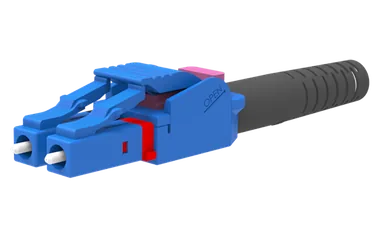
Connector
Duplex LC on a single round cable with tool-less polarity reversing and a latch lock, for tidy cords with a field fix.
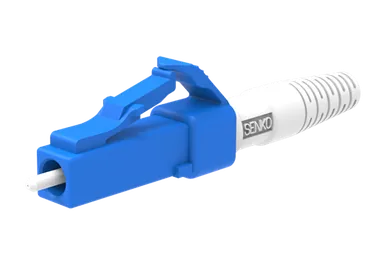
Connector
Flagship LC connector with a robust unibody and precision ferrules, exceeding GR-326-CORE, in UPC and APC, single-mode and multimode.
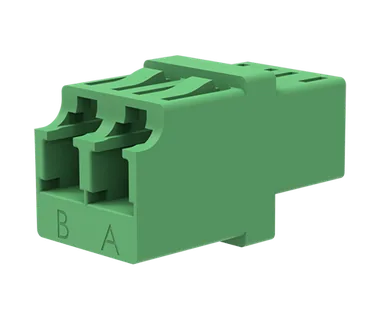
Adapter
Compact LC coupler that fits industry RJ-45 style outlets and panels, the plain default adapter for general patching.
All lc connectors and adapters or browse the full connector range
Send the part, quantity and drawing. An engineer replies with questions or a quote.
Fill in what you know. An engineer replies from sales@radixfibrotech.com, Monday to Friday, 09:00 to 18:00 India time. Prefer to talk? Call +91 99702 02526.
Your reference is . A confirmation is on its way to your inbox. We reply from sales@radixfibrotech.com, Monday to Friday, 09:00 to 18:00 India time.
Urgent, or have a drawing? Send the reference on WhatsApp and we will pick it up there.