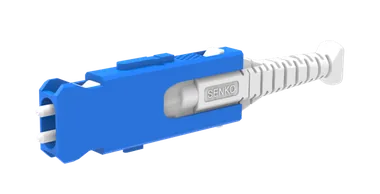
Connector
SN 1.6 mm and 2.0 mm Connector
Standard-boot SN duplex connector for 1.6 mm and 2.0 mm cable: very small body, carrier grade loss and room for 400G density.
- Duplex
- High density
- Single-mode
Click the photo to enlarge
SN EZ-Flip duplex connector with changeable polarity, so A-B and B-A can be set without re-terminating.
The SN EZ-Flip is a polarity-changeable SN duplex connector, described by the manufacturer as a duplex Base-2 connector. Its transmit and receive positions can be swapped after build, which saves recabling when a link is wired the wrong way. Radix can supply it loose or on cords.
| Type | Duplex SN connector, polarity changeable (EZ-Flip) |
|---|---|
| Fibre count | 2 fibres (Base-2) |
| Fibre type | Single-mode and multimode |
| Polish | UPC and APC (single-mode) |
| Typical insertion loss | 0.05 to 0.12 dB single-mode, 0.05 dB multimode |
| Maximum insertion loss | 0.15 to 0.25 dB single-mode, 0.15 dB multimode |
| Return loss | At least 55 dB UPC, 65 dB APC, 25 dB multimode |
| Operating temperature | -40 to +75 C |
| Durability | Under 0.2 dB change after 500 matings |
| Ferrule | 125 um single-mode, 127 um multimode |
Figures are the manufacturer's published values for the product family and grade; check the data sheet for the exact part number you order. Radix confirms the build in your quote.
| Fibre type | Single-mode, Multimode, or other on request |
|---|---|
| Polish | UPC, APC, or other on request |
| Grade | Premium, Low Loss, or other on request |
| Packaging and labelling | On request |
Radix supplies this part loose, or built into patch cords, pigtails and assemblies to your drawing, quoted by form, phone or WhatsApp from Pune.
Send us:
Add this part to your list, add more parts, then send one request.
The SN EZ-Flip connector is a polarity-changeable SN duplex connector. The manufacturer describes it as a duplex Base-2 connector. In plain terms it is an SN pair whose transmit and receive positions can be swapped after the connector has been built, so a link wired the wrong way round can be corrected without cutting the cord or throwing it away. It belongs to the SN connector family and shares that family's loss and return loss figures.
Polarity is the commonest cause of a link that is built, tested for loss and yet will not come up. The fibre is fine, the connectors are clean, and the transmitter is talking to the transmitter. A plug that can be flipped removes that whole class of fault from the stock list.
Radix can supply the EZ-Flip plug loose, or built into patch cords and cable assemblies to your drawing. The part is and quoted by form, phone or WhatsApp from Pune.
A duplex link has two fibres. At each end, one is the transmit side and the other is the receive side. For a link to work, the transmit fibre at one end must reach the receive port at the other. Over a single cord this is automatic if the cord is a cross. With patch panels in the middle, there are several cords and adapters in a chain, and the number of crossovers across all of them must be odd. It is easy to build a chain with an even number.
Different sites choose different methods: build every cord straight and let the panel cross, build crossed cords, or cross at a cassette. Each method is sound, but mixing them gives faults. The same problem exists in multi-fibre systems, as shown in the MPO polarity guide.
A flippable plug turns a wrong build into a quick job: swap the pair, retest, and carry on. The polarity testing guide explains how to confirm the result.
| Item | Single-mode | Multimode |
|---|---|---|
| Typical insertion loss | 0.05 to 0.12 dB by grade | 0.05 dB |
| Maximum insertion loss | 0.15 to 0.25 dB by grade | 0.15 dB |
| Return loss, at least | 55 dB UPC, 65 dB APC | 25 dB |
| Ferrule fibre size | 125 um | 127 um |
| Temperature range | -40 to +75 C | |
| Durability | under 0.2 dB change after 500 matings | |
A changeable-polarity design must still keep the ferrule pair aligned after a flip, so ask for the data sheet to see what, if any, loss change is stated for a flipped connector. Do not assume that a flipped plug and a fresh one are identical until the figure is in front of you. After any flip, clean, inspect and test the link as you would a new one.
Never flip a plug in a live link, and never flip it with a bare fingertip on the ferrule. Keep the cord strain-free during the step, since the cable should not twist as the connector turns. The inspection method is in the end face cleaning and inspection guide.
It is of less value where a design is fixed and documented, since a fixed plug is simpler. A changeable connector is a flexible part, and flexibility has a small cost: another moving feature that could be mishandled. Use it where the benefit is real.
| Plug | Main feature | Polarity |
|---|---|---|
| SN 1.6 mm and 2.0 mm | Standard boot for thin round cable | Set at build |
| SN Uniboot | One boot for both fibres | Set at build |
| SN EZ-Flip (this page) | Polarity can be changed on the connector | Changeable |
| SN Mini BTW | Shortest body, behind the wall | Set at build |
The CS family has its own changeable plug, described on the CS EZ-Flip connector page, for those who work with the CS duplex format. The two are not interchangeable, because the housings are different.
A plug that can change polarity also needs a record of what it is set to. If nobody writes the state down, the next engineer cannot know whether a cord is straight or crossed without testing it. Use a small flag or a colour mark on the cord near the plug, or keep a port list, and update it at every flip. The labelling and documentation guide suggests fields that are worth keeping.
For acceptance, test polarity at the end of the build as well as loss. A visual fault locator or a light source at one end and a meter at the other shows at once whether the pair is crossed the way the drawing says. Do this before the equipment is attached, so the first power-up is not also the first polarity check.
Assumed values: a site buys 200 SN duplex jumpers a year for three different projects, two that use a straight method and one that uses a crossed method. Under fixed polarity, the buyer must hold two kinds of cord and label them well.
These numbers are assumed for illustration. The aim is to show what is being traded: a slightly more complex plug against a simpler stock list.
Send the cord drawing or list, the fibre details and the quantity, and say that a changeable plug is wanted. If cords are built, Radix tests each cord before dispatch. Use request a quote, or send the details by phone or WhatsApp. The RFQ guide lists useful fields, and the fibre optic patch cords page describes the cord formats we build.
The connector hub lists the other duplex formats.
It is a polarity-changeable SN duplex connector, described by the manufacturer as a duplex Base-2 connector. Its transmit and receive positions can be swapped after it is built.
A duplex link works only if transmit meets receive at the far end. A chain of cords and adapters with the wrong number of crossovers will not link, and a flippable plug lets you correct it.
Ask for the data sheet figure for a flipped connector. After any flip, clean, inspect and test the link.
It belongs to the same SN family and mates in SN adapters, but check the data sheet for body length if space is tight.
The SN family is listed as fitting 400G transceivers including QSFP-DD, OSFP and SFP-DD. Confirm the plug and cage fit on the data sheets.
Yes makes a CS EZ-Flip connector. The two are not interchangeable because the housings differ.
The SN family is listed in both polishes. Return loss is at least 55 dB UPC and 65 dB APC on single-mode.
Yes. Radix can supply the connector loose or built into patch cords and cable assemblies to your drawing.
Connector
Standard-boot SN duplex connector for 1.6 mm and 2.0 mm cable: very small body, carrier grade loss and room for 400G density.
Connector
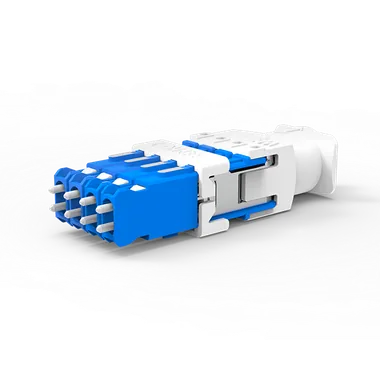
Four duplex SN connectors in one push-pull body: patch Base-8 and Base-2 links in a single operation without cassettes or fan-outs.
Adapter
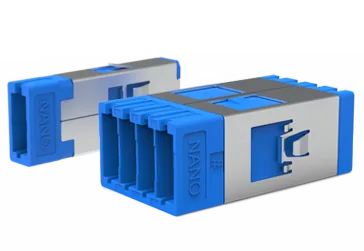
Non-shuttered SN adapter in 1-channel or 4-channel form; the single channel suits separated links such as coherent optics.
Component
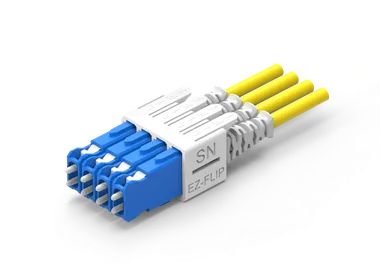
Gang clip that holds four SN connectors side by side so they plug into shuttered adapters in one operation.
All sn connectors and adapters or browse the full connector range
Send the part, quantity and drawing. An engineer replies with questions or a quote.
Fill in what you know. An engineer replies from sales@radixfibrotech.com, Monday to Friday, 09:00 to 18:00 India time. Prefer to talk? Call +91 99702 02526.
Your reference is . A confirmation is on its way to your inbox. We reply from sales@radixfibrotech.com, Monday to Friday, 09:00 to 18:00 India time.
Urgent, or have a drawing? Send the reference on WhatsApp and we will pick it up there.