Range
MTP MPO cable assemblies
Trunks, patch cords, breakouts and conversion harnesses, built in Pune to the fibre count, polarity and length on your drawing.
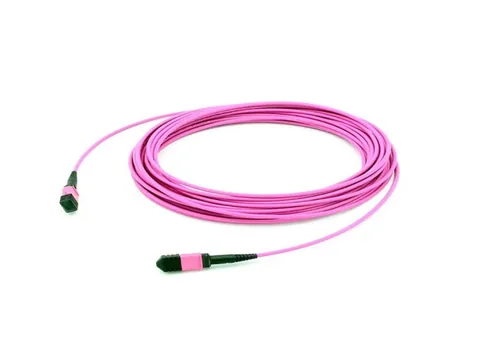
Click the photo to enlarge. Illustrative photo of a Radix assembly; yours is built to your specification.
Thinner MPO trunks let more fibres through crowded trays and conduits. This page explains how they are built, what they give up and how to specify one.
A small-diameter MPO trunk carries the same fibres as a standard trunk in a thinner cable, made with finer coated fibre, a thinner jacket or finer strength members. It fits more fibres through crowded pathways but usually has lower pulling tension and crush resistance. Specify the outside diameter, rating and connector end, and send the drawing for a quote.
Radix builds this to your drawing in Pune and quotes by form, phone or WhatsApp. An engineer reads every request.
Send us:
Add this item to your list, add more items, then send one request.
A small-diameter or high-density MPO trunk cable carries the same fibres as a standard trunk in a thinner cable. The goal is to fit more fibres through a tray, a conduit or a cable manager that is already crowded, and to make the cable easier to route behind a rack. There is no single industry definition of "slim" or "small diameter", and makers use the words for cables that range from slightly thinner than standard to much thinner. For a buyer, the useful definition is a number: the outside diameter of the cable, in millimetres, for the fibre count and jacket you need.
This page explains how a trunk can be made smaller, what that costs in strength and handling, how to work out whether the saving matters for your route, and what to put in a request. It is buyer education, and not a statement that any specific diameter is stocked. Radix Fibrotech builds MTP and MPO assemblies to the customer's drawing in Pune. For small-diameter constructions, send us the drawing and we reply with what we can build. The wider family of cables is on the MTP and MPO cables page, and the general trunk type is described at MPO trunk cables.
A trunk cable is a stack of layers: fibre, coating, buffer or sub-unit, strength members, and an outer jacket. Reducing diameter means thinning one or more of them, and each change has a consequence.
| Change | What it does | What it costs |
|---|---|---|
| Thinner coating on the fibre (for example 200 micron instead of 250 micron) | Each fibre is smaller, so the bundle shrinks | The fibre needs more careful handling, and the connector must be made for it |
| Bend-insensitive fibre | Allows a tighter bend radius and a smaller cable body without added loss | Does not change the connector or boot, which still set a limit |
| Thinner jacket | Directly reduces outside diameter | Less protection against crush and abrasion |
| Fewer or finer strength members | Reduces the body size | Lower pulling tension rating |
| Ribbon or flat construction | Packs fibres in a row, shaped for thin spaces | Bends easily in one direction only and needs care in routing |
| Removing sub-unit buffering | Saves space | Fibres are less protected from the jacket and from each other |
A well-made small cable balances these, so that the cable still meets the mechanical tests in the data sheet. For indoor cables the relevant cable standards are the IEC 60794-2 family, which sets out tests for tensile load, crush, impact, bend and temperature. Ask the supplier which tests the offered cable passes and at what values. Do not compare diameters alone, because two cables with the same outside diameter can differ greatly in strength.
Conduit and duct fill rules limit the share of the cross-section that cables may occupy. A commonly used limit for three or more cables in a conduit is 40 percent of the internal area, as in US electrical and telecommunications practice, but you must check the code or specification that applies to your site.
Assumed values: a conduit with a 35 mm internal diameter, 40 percent fill, and 12-fibre MPO trunk cables of three different outside diameters (the diameters are assumed for the example and are not product figures).
| Cable outside diameter | Cable area | Cables that fit | Fibres carried |
|---|---|---|---|
| 4.5 mm | 15.9 mm² | 24 | 288 |
| 3.0 mm | 7.07 mm² | 54 | 648 |
| 2.0 mm | 3.14 mm² | 122 | 1,464 |
Fill is proportional to the square of the diameter, so a one-third cut in diameter (4.5 to 3.0) more than doubles the number of cables, and a cut to 2.0 mm gives five times as many. The table is an upper bound, because round cables cannot pack perfectly and a real pull needs clearance. It also shows the limit of the saving: the MPO connector at each end is roughly 12 mm wide, and it has to be pulled through the same conduit or protected by a pulling sleeve. For a full run, the connector, not the cable, may set the smallest bore you can use. Our guide to MPO trunk cables with a pulling eye explains how the connector is protected.
A smaller cable has a smaller minimum bend radius in absolute terms, which is the reason it routes well. Many indoor data sheets state a bend radius of about 10 times the cable outside diameter with no load, and about 20 times under pulling load. A 3.0 mm cable would then need 30 mm at rest and 60 mm under load, and a 4.5 mm cable would need 45 mm and 90 mm. Those are examples of a common rule of thumb and the data sheet for the offered cable decides. The bend-insensitive fibre inside may tolerate a much tighter bend than the cable jacket does, but the cable limit is the one that counts. Our guide to bend radius for fibre cable and the page on macrobend and microbend loss explain the loss mechanisms.
The cost of a smaller cable is usually a lower rated pulling tension, because there is less strength member. Hauling a thin trunk through a long conduit with a cable grip on the jacket can overload it. Use the pulling eye or the strength member as designed, pull by hand or with a tension-limited tool, and use lubricant if the duct run is long. The limits and practical checks are set out in our guide to MPO bend radius and pulling tension and the installation checklist.
The cable can shrink, but the MPO ferrule and housing cannot. An MTP or MPO connector is a fixed-size part with a boot at the rear that guides the cable out. A smaller cable needs a matching boot so the cable does not bend sharply at the entry, and so the strain relief works. In a dense panel, the stack of connectors across the face and the cable leaving each one can interfere with the neighbours, and a boot with a low profile or a short body helps.
The jacket does two jobs in a thin cable: it protects the fibres and it carries the fire rating. In many data halls the specification requires a low smoke, zero halogen jacket, covered in our guide to fibre cable jacket types. In North America the cable has to carry a rating such as riser or plenum under the national electrical code (Article 770 for optical fibre cables), and in Europe the Construction Products Regulation classes cables by reaction to fire. A thinner jacket must still pass the fire test, so check that the offered construction carries the rating you need, and ask for the rating in writing.
Do not assume a thin cable has the same fire class as a standard one from the same maker. Ask for the data sheet and the rating mark for the exact construction. Our page on low smoke LSZH MPO trunk cables covers the zero halogen option.
| Mistake | Consequence | Better practice |
|---|---|---|
| Choosing on diameter alone | A thin cable that cannot take the pull or crush in your route | Compare rated tension and crush values, and not just millimetres |
| Forgetting the connector width | The trunk cannot be pulled through the bore | Use a pulling sleeve or choose a larger conduit |
| Using a standard boot on a thin cable | Sharp bend at the entry and extra loss | Ask for a boot matched to the cable |
| Pulling by the jacket | Strain on the fibres | Pull on the strength member or eye as designed |
| Ignoring fire rating | Cable fails the site inspection | Ask for the rating on the offered construction |
| Mixing thin and standard trunks without labels | Wrong replacement later | Mark the diameter on the label and the drawing |
| Over-filling the conduit to the limit | No room for future pulls | Leave spare capacity, 20 to 30 percent as a common margin |
Radix Fibrotech makes MTP and MPO assemblies to the customer's drawing and bill of materials in Pune, with lengths, fibre counts, polarity, jacket and marking as you state them, and quotes by form, phone or WhatsApp. Radix tests each cord before dispatch. Whether a particular small-diameter construction can be built depends on the cable and the connector, so send us the drawing and we reply with what we can build. Include your target outside diameter and the pathway it must fit. Use the request a quote page, and see the other options under MPO cable assemblies for OEMs and integrators.
It is an MPO or MTP trunk built with a thinner cable body than the standard version for the same fibre count, so more of them fit in a tray or conduit. There is no single industry definition of slim, so ask for the outside diameter in millimetres.
They use smaller coated fibre, bend-insensitive fibre, a thinner jacket, finer strength members or a flat construction. Each change reduces diameter and also reduces some protection, such as crush resistance or pulling tension.
Fill depends on the square of the diameter. With a 40 percent fill limit in a 35 mm conduit, assumed diameters of 4.5, 3.0 and 2.0 mm allow 24, 54 and 122 cables. Real pulls need clearance, so treat it as an upper bound.
Usually it has a lower rated pulling tension and less crush resistance, because there is less strength member and jacket. Compare the rated values in the data sheet, and use a pulling eye or strength member as designed.
Many indoor data sheets state about 10 times the outside diameter with no load and about 20 times under pulling load. The data sheet for the exact cable decides, and the connector boot may set a larger limit.
Only if the connector fits. The MPO connector is roughly 12 mm wide, so the smallest bore may be set by the connector. Use a pulling sleeve to protect the connector during the pull.
It can, but the rating depends on the exact construction and not on the diameter. Ask for the fire rating of the offered cable in writing and check it against the site specification.
Radix builds MTP and MPO assemblies to the customer's drawing. For a small-diameter construction, send the drawing with fibre type, count, target outside diameter and pathway limits, and we reply with what we can build.
Range
Trunks, patch cords, breakouts and conversion harnesses, built in Pune to the fibre count, polarity and length on your drawing.
Range
MTP and MPO trunk cables for the permanent backbone between racks, rows and rooms, built to the measured route length.
Range
MPO and MTP trunks with a protected pulling end for conduit, duct and riser routes, made to your drawing.
Range
MPO and MTP trunks with a metal armour layer for routes where crush, rodents or rough handling are real risks, made to your drawing.
How to work out the right length for a factory-terminated MPO trunk: measuring the route, slack, loops, tolerance and ordering mistakes, with worked examples.
Read moreIndustryFibre assemblies for data centres and enterprise networks: MTP/MPO trunks and patch cords for 400G and 800G, armoured campus links, and what to specify.
Read moreContactSend your drawing or requirement.
Read moreSend the fibre type, count, connectors, length and quantity. An engineer replies with questions or a quote.
Fill in what you know. An engineer replies from sales@radixfibrotech.com, Monday to Friday, 09:00 to 18:00 India time. Prefer to talk? Call +91 99702 02526.
Your reference is . A confirmation is on its way to your inbox. We reply from sales@radixfibrotech.com, Monday to Friday, 09:00 to 18:00 India time.
Urgent, or have a drawing? Send the reference on WhatsApp and we will pick it up there.